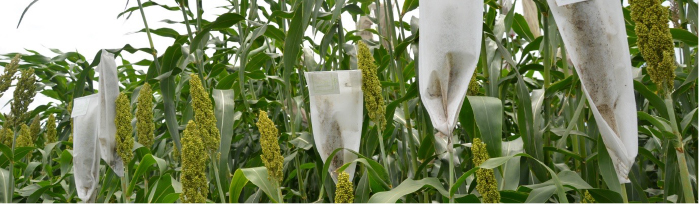
Pollination control bags and tents can support sorghum breeding at various stages of the breeding cycle. In the early stages of crossing, pollination bags can help breeders manage sorghum progeny. Once breeders reach the seed scale-up stage, PBS International pollination control can increase seed yields by 652%.1
Why is pollination control important in sorghum breeding?
Pollination control is important when breeding any kind of grain crop, particularly in a commercial setting or at scale.
In sorghum and grain breeding, the main benefits include:
- Close control over pollination – undesirable pollen stays out while desired pollination takes place.
- Protection against bird and insect damage.
- Protection against adverse weather such as extreme heat or rainfall.
- Protection against mould (provided the bags are breathable and reduce humidity build up).2
However, it is important for sorghum breeders to invest in quality products to facilitate sorghum pollination control.
Why is the timing of pollination control important in sorghum?
The type of pollination control strategy used by a breeder depends on which point during the breeding cycle the breeder is currently working in.
Let’s look at an example – a sorghum breeder is trying to create a new sorghum hybrid variety with specific traits. Once established, the hybrid seed production will be scaled up for commercial launch.
To start with, the breeder will take two varieties and manage pollination between these plants with the aim of developing a hybrid that inherits desirable traits from either parent – in progeny terms, this will be the first-generation offspring, or F1. Pollination control at this stage is important as the breeder wants to closely manage the pollen exposure to ensure that only the desired pollination takes place.
The F2 sorghum progeny (the next generation after the initial hybrid) often show great genetic diversity, allowing breeders to select specific traits to breed into the F3 generation, such as drought tolerance or grain colour.
Once a variety has been successfully bred, and a sorghum foundation seed established, scale-up and maximising yields becomes a priority. Hybrid plants (such as the F1 and F2 generations) often experience ‘hybrid vigour’ or heterosis, producing significantly more seeds than a self-pollinated plant. However, once the foundation seed is established, pollination control becomes important for different reasons – the breeder will need to produce the desired seed at scale for commercial launch, meaning pollination control is needed not only to manage the pollination, but also to protect against bird and insect damage, adverse weather, and other factors, to maximise yields.
At scale-up stage, breeders also need to consider space and labour. Progeny rows for different varieties must be planted with over a mile separating different breeds, to avoid cross contamination from other sorghum plants. This results in increased labour and time spent on managing crosses, as breeders need to travel between sites to manage different progeny rows. At this stage, pollination control remains essential, as breeders must carefully manage progeny rows to ensure no cross-contamination occurs, as this would result in undesired crosses and breeding outcomes.
What is the most effective pollination control for sorghum breeding?
The type of pollination control used by sorghum breeders has a direct impact on the quality and yield of the crop.
Traditionally, sorghum breeders have used paper bags for pollination control, but these come with challenges:
- Heat build-up – paper bags offer no breathability, meaning temperatures can rise within the bags and damage the panicles.
- Bird damage – many birds have learned that paper bags can easily be ripped, meaning that they offer little protection – especially problematic in high-value crosses.
- Mould incidence – as sorghum grows in dry climates, it is often sensitive to small amounts of moisture. Due to lack of breathability in paper bags, mould can occur quickly in high humidity, or if paper bags get wet during rainfall.
- Lack of UV – photosynthetically active radiation (PAR) is the spectral waveband of solar radiation that facilitates photosynthesis. Paper bags do not transmit enough of this radiation through to contained panicles, which can affect grain colour and subsequent taste.
PBS International 2D42 SG1 bags have been designed specifically for sorghum breeding. The SG1 fabric, part of our duraweb® family of materials, has been trialled by leading sorghum breeders, and offers proven benefits:
- Strong protection against birds – When trialled against uncovered panicles and paper bag-covered panicles, SG1 bags have consistently proven most effective against birds,1,2 helping to better protect high-value crosses.
- Up to 652% increase in yield1 – perfect for seed scale-up programmes.
- Allows for better UV penetration – Bags are white and allow sunlight to pass through, transmitting up to 35% of the PAR to the contained plant, helping to improve and maintain desired grain colour.
- Breathable – Thanks to the randomly laid fibre structure of our duraweb® materials, air can still pass through the bag while halting pollen down to 15 microns, reducing the risk of temperature and humidity build-up.
- Reusable – Bags can be cleaned and stored for use the following year, helping to save costs long-term.
PBS International duraweb® bags therefore overcome all the major challenges associated with paper bag pollination control strategies. Papers by Schaffert et al and Gaddameedi et al both compared PBS International sorghum bags made with duraweb® material to paper bags, and found that the PBS Internation bags consistently out-performed paper bags in terms of bird predation, panicle weight, average seed weight, water resistance, intactness, ease of handling, and mould and diseases resistance.1,2
In addition to bags, PBS International also manufactures patented tents, which can help breeders during seed scale-up phases. The Citadel Mini and Maxi tents have been built specifically for plant breeding. Their modular design allows for custom set-up depending on the breeders’ needs, isolating plants from external pollen while allowing pollination to occur naturally between contained plants. During seed scale-up, this will allow breeders to plant different progeny rows side-by-side without risk of pollen contamination – offering huge time and labour savings.
How are sorghum breeders using PBS International pollination control?
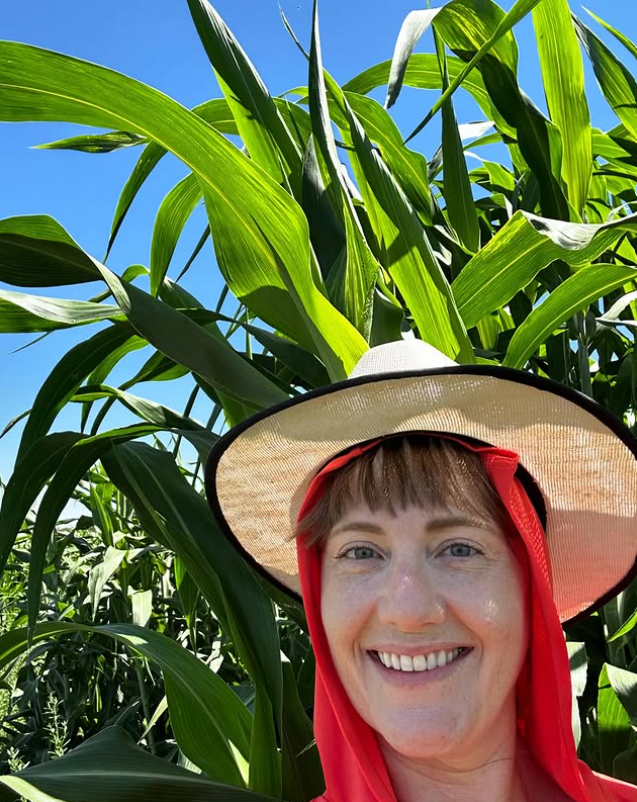
Professor Melinda Yerka runs the Yerka Lab at the University of Nevada, Reno, and is also the founder and CEO of the Yerka Seed Company which brings new commercial sorghum varieties to market.
In 2022, Prof. Yerka trialled PBS International bags after coming across the products when searching for a bag that offered pollination control while reducing temperature build up. Prof. Yerka is also a member of the NAPB, and during this time, met with our CEO Hannah Senior who was NAPB President between 2022-2023. Her experiment consisted of placing three PBS International bags alongside three paper bags on each variety to compare performance. The results found that the panicles covered by PBS International bags achieved:
- Less grain shrinkage and collapse
- Improved seed sets in hotter conditions
- Better protection against birds
- Bags can be washed and re-used the following year.
You can read Prof. Yerka’s full case study here.
Where can I buy PBS International products for sorghum?
Ordering PBS International bags and tents has never been easier. We are also offering 20% off the list price for our patented Citadel Midi and Maxi tents for orders shipped before 31 December 2026.
To purchase PBS International bags and tents for your sorghum project, contact us today.
To browse our range of bags and tents that are suitable for sorghum and grain breeding, visit our dedicated page.
FAQs
Q: How does pollination control improve sorghum breeding?
A: Quality pollination control protects plants against external contamination, while also offering additional benefits. PBS International bags, which are made with duraweb® material, offer improved breathability to reduce humidity and temperature build up, mitigating mould and disease incidence, and high tensile strength also protects plants from bird damage.
Q: Which pollination control product is best for me?
A: We offer a wide range of bags and tents to suit a variety of pollination control needs. You can visit our products page or our product guide to see our standard range of products.
Our bags are suitable for every stage of sorghum pollination and growing, from developing foundation seeds to scale-up, but based on discussions with sorghum breeders, we believe our tents are especially well-suited to seed scale-up prior to commercial launch of new sorghum varieties.
Q: I can’t find a pollination control product that would work for my particular requirements. Can I request a bespoke product?
A: Yes! We have a wide range of bags and tents to suit a variety of plant breeding needs, but we also offer a custom design service to support plant breeders with more unique requirements. We’ve developed sleeves, bags with spouts, bags with more windows, taller tents, and more. If we create a product that has real potential to help other plant breeders, we will also add it to our standard products list.
You can read more about how we support custom projects in this blog, and contact our team for more information.
Glossary
Crossing: The process of facilitating pollination between two specific parent plants to create offspring with specific traits.
duraweb®: PBS International’s proprietary range of materials used to make pollination control bags and tents. The material is made of randomly laid polyester fibres, which stop pollen from passing through, while still allowing air and light through. This fabric also offers high tensile strength, making them resistant to tearing (from either sharp plants or external threats such as birds).
Heterosis: Also known as hybrid vigour, heterosis refers to the phenomenon where the first generation of offspring (from a crossing between two select parent plants) outperforms its parents in traits such as seed yield, growth rate, disease resistance, and more. This is because breeding two distinct parent plants (as opposed to self-pollinating / inbreeding) results in offspring having a wider gene pool, meaning stronger traits become dominant while recessive genes are minimised.
Progeny: Refers to the offspring of a parent plant. Progeny testing involves checking an offsprings genetic makeup to see which traits have been passed down by parent plants, while progeny rows refer to the field plots where seeds from a single parent plant are grown together in one line, allowing breeders to identify superior varieties and facilitate seed scale-up.
References
[1] Schaffert, R. E., Virk, D. S., & Senior, H. (2018). Are nonwoven synthetic pollination bags a better choice for sorghum breeding?. Journal of Plant Breeding and Crop Science, 10(3), 58-68. https://academicjournals.org/journal/JPBCS/article-abstract/2E1484056061
[2] Anil Gaddameedi, Are Ashok Kumar, Rahul Madhavrao Phuke, Daljit Singh Virk and Hannah Senior, 2017. Evaluating the Efficacy of Synthetic Fibre Pollination Control Bags in Sorghum During the Rainy Season. International Journal of Plant Breeding and Genetics, 11: 39-54. https://scialert.net/abstract/?doi=ijpbg.2017.39.54